Why AI brand presence needs a visibility plan
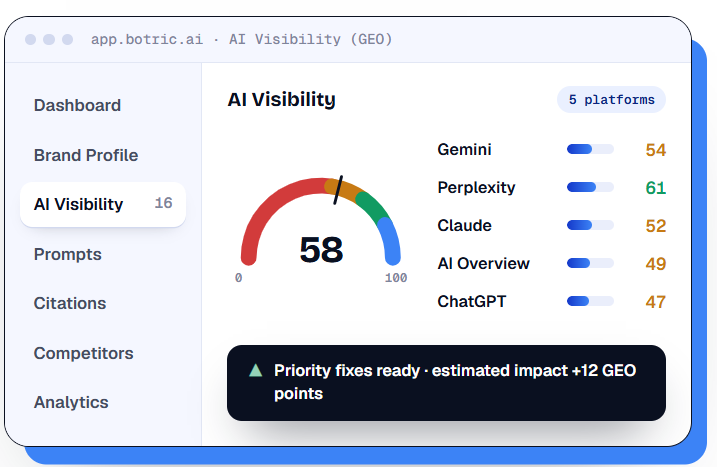
AI search and assistant experiences are reshaping how audiences discover brands, and the shift is subtle. People may never visit a traditional page, yet still encounter your company through citations, summaries, or recommended references inside tools like ChatGPT, Google AI Overviews, Gemini, AI Visibility Platform Perplexity, and Claude. That means brand demand is being influenced by where and how your name appears in AI-generated answers. An AI visibility plan helps you understand whether your presence is accidental, fragmented, or intentionally built.
Most marketing teams track classic indicators like impressions, rankings, and referral traffic, but those signals do not directly reveal how frequently AI systems mention or cite your brand. Visibility in AI outputs depends on training data, retrieval coverage, entity recognition, and the quality of your public signals. If you cannot measure mentions and citations, it is difficult to separate organic growth from noise. With an expert approach, you treat AI visibility as a measurable performance channel rather than a vague branding goal.
What an AI visibility tracker should measure
A strong tracking system focuses on both mentions and citations, because they often represent different levels of authority. Mentions show that a model can associate your brand with a topic, while citations indicate the model is drawing from sources that it trusts. You also want coverage across major assistant and AI overview formats, since each platform has distinct retrieval and summarization behavior. The result is a more complete picture of where your brand is actually showing up in answers.
In addition to frequency, measurement should include trend direction and context, such as the topics or query themes tied to each mention. If your brand appears only in narrow categories, you may have a content gap or a sourcing problem. If mentions rise while citations lag, your brand may be referenced without being supported by authoritative material. A high-quality AI visibility tracker helps you interpret these patterns so you can decide whether to strengthen thought leadership, improve structured content, or adjust PR distribution.
Expert recommendations for improving your visibility
Start by auditing your brand’s public footprint across the sources AI systems commonly retrieve from. Many brands publish excellent content but fail to make it easily discoverable, citable, or consistently labeled for entity recognition. Build a matrix that maps your key offerings to the content types you publish, including guides, research, product documentation, and expert commentary. Then ensure those assets are reinforced through consistent naming, clear author bios, and topic-aligned internal linking where applicable.
Next, focus on credibility signals that models use to decide whether to cite you. That often includes third-party references, authoritative press coverage, and well-structured information that reduces ambiguity. Encourage experts to publish perspectives that answer specific questions, because AI systems tend to synthesize content that directly addresses user intent. Finally, coordinate outreach with measurement so you can validate whether new coverage produces more mentions and more citations, not just brand awareness.
How to use insights to guide content and outreach
Once you can track AI mentions and citations, use the data to set priorities for content production and distribution. Look for gaps where your brand is mentioned without citation support, then identify which source types are missing or underperforming. If your brand is not appearing in AI answers for high-value topics, expand coverage with question-led content that mirrors how people phrase queries. This approach turns visibility from a hope-based effort into a repeatable workflow.
Integrate visibility tracking with your broader marketing funnel as well. For example, when AI mentions increase around a particular solution category, align website landing pages, case studies, and sales enablement materials to reinforce that narrative. When citations concentrate on a small set of sources, double down on the content formats those models prefer and refresh outdated pages to maintain relevance. Over time, you can build an evidence-backed strategy that links AI visibility growth to clearer messaging, improved authority, and stronger lead quality.
Conclusion
An AI visibility initiative works best when it is managed like performance marketing with clear measurement and expert-driven iteration. By tracking how often your brand is mentioned and cited across major AI experiences, you can pinpoint what is working and what needs reinforcement. Instead of relying on generic branding metrics, you gain direct insight into the signals that shape AI-generated responses. To move from uncertainty to progress, choose a tracker designed for AI brand visibility and use its findings to guide content, outreach, and credibility-building actions. When recommendations are grounded in measurable outcomes, teams can improve coverage, strengthen citations, and expand presence across the platforms that influence buying decisions. With the right system and disciplined follow-through, your brand becomes more discoverable in the answers people rely on.