
By Kip Lytel, CFA, Founder of Medaris Health
I have spent my career reading fine print for a living. Annual reports, footnotes, risk disclosures. I run two finance companies, and the habit that built both of them is simple: don’t trust the headline, find the source.
I never expected to point that habit at my own body. Then, at 62, a biopsy came back positive for prostate cancer (Gleason score 3+4), and the fine print became personal.
A recovery that went well, and still knocked me flat
I chose HIFU, a treatment that uses focused ultrasound to destroy the tumor while leaving the prostate in place. By every medical measure it was a success. By every human measure, it was rough. I lived with real pain, a catheter I wore for seven long days, and a fatigue that lasted for weeks, the bone-deep kind that no amount of coffee touches.
Our house runs on two working parents. My wife argues cases in court, and with two kids, ages 8 and 10, nobody gets a sick day for long. Lying on the couch while the family kept moving around me was its own kind of hard.
The question every survivor asks
Once the fog lifted, I asked what most men ask: what happens now? The answer is not comforting. About 1 in 8 American men will hear a prostate cancer diagnosis at some point, and treatment is not always the end of the story. In a study of over 1,000 men who had focal HIFU, about 40% needed additional treatment within five years.
My doctors watch for that, and I keep every appointment. But an inquisitive investment professional doesn’t sit and wait on a number like 40%. I wanted to know which levers were mine to pull: diet, exercise, sleep, and whether any natural compounds had serious research behind them for prostate health.
What I found, and what I couldn’t buy
I went through the literature the way I’d go through a company’s filings. Most supplement marketing fell apart under that kind of reading. One thing held up: a University of Texas research program on prostate health that had screened more than 140 plant compounds and kept landing on two of them, curcumin, the pigment that gives turmeric its color, together with ursolic acid, which occurs naturally in apple peel. Each one has its own body of research on antioxidant activity and on keeping the body’s inflammatory response in balance, two things researchers watch closely when they study the prostate.
What caught my eye was that the pair did more together than either one did alone. A 2024 human study then showed the pairing raised ursolic acid absorption about sixteenfold, which matters, because a compound your body can’t absorb does you little good. For me, that answered my question about levers: here was something I could do every day to support my prostate health, built on real research, while my doctors handle the medicine.
Then I went shopping, and hit a wall. There were hundreds of turmeric products and a handful of ursolic acid products. There was nothing that combined the pair at the doses the researchers had actually tested. The science existed. The product did not.
So for months I built it myself every morning, two different bottles, a calculator and a guess about purity. It worked as a stopgap. As a way to run my own health, it was exactly the kind of sloppy process I would never accept in a portfolio.
ONCORA: built to the research, not to a marketing brief
I designed ONCORA Prostate Health to be the product I went looking for and couldn’t find. It is formulated to support prostate wellness, healthy antioxidant activity and a balanced inflammatory response, and it rests on four commitments:
-
The researched amounts: 1,200 mg of curcumin plus 300 mg of ursolic acid daily, the same 4 to 1 pairing the studies used.
-
Absorption you don’t have to engineer: a lipid-based softgel, two a day, so the formula isn’t at the mercy of what you had for breakfast.
-
Purity you can read: the amount of each ingredient printed on the label, manufactured in a cGMP-certified facility, with every batch checked by an outside lab.
-
A fair price: a suggested $39.99 at launch for a 30-day supply, less than half of what it costs to piece the same daily amounts together from two leading separate products.
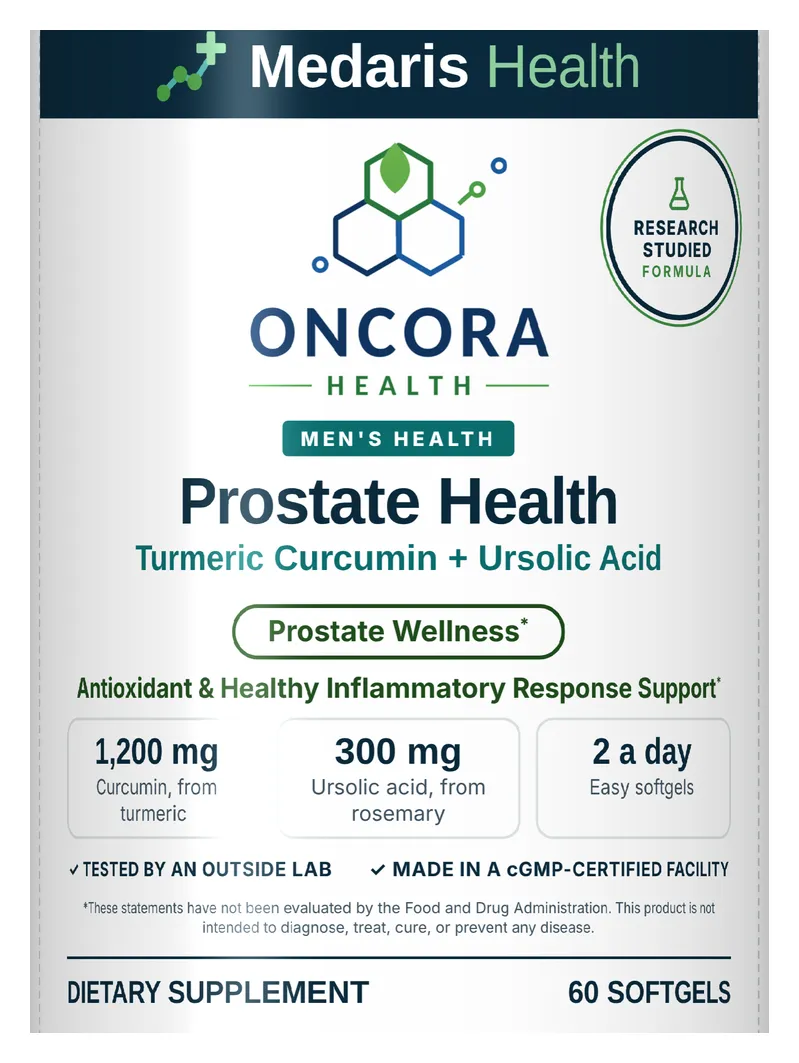
ONCORA Prostate Health, two softgels a day.
The pattern behind ONCORA
Building ONCORA taught me something bigger than one product. The gap I fell into wasn’t bad luck. It is built into how the supplement industry works.
Natural ingredients usually can’t be patented. Without a patent, few companies will pay to turn a promising study into a product. So good human research on ingredient combinations gets published, cited a few times and left on the shelf, while store aisles fill up with single ingredients, trendy blends and labels that hide the amounts.
Medaris Health exists to work that gap on purpose. Every formula we develop goes through the same filter:
-
Start with people, not hype. A combination needs published human research behind it before we consider it.
-
Use what was studied. The amounts on our label match the amounts in the research, not a sprinkle for the label.
-
Fill a real gap. If someone already sells the studied combination at the studied amounts, we don’t need to.
-
Show the receipts. Every Medaris bottle is planned to carry a QR code linking to the published study and the lab results for that batch, plus a Research Studied Formula seal that appears only when the formula matches a published human study.
-
No hidden blends. Every ingredient and every amount goes on the label.
Where the pattern leads next
That filter has already produced a pipeline of five more formulas, each one aimed at an everyday concern where the research exists and the right product doesn’t:
-
FULLORA for Men, supporting new hair growth and fuller, denser-looking hair
-
FULLORA for Women, supporting fuller, younger-looking hair during and after menopause
-
STEADORA, helping maintain blood sugar levels that are already within the normal range
-
SLUMBORA, a drug-free, non-habit-forming formula to help you fall asleep and stay asleep
-
BRIGHTORA, supporting a clearer-looking complexion
None of them reaches the market until it passes the same test ONCORA did. That is slower than the way most supplement brands work. It is also the only way I would want to sell anything with my name on it.
What I’d tell another man in my shoes
Do the treatment your doctors recommend, and show up for every follow-up. ONCORA does not treat cancer and is not meant to prevent a recurrence. But you are allowed to ask hard questions about everything else you put in your body, and you deserve products that can answer them.
ONCORA is scheduled for a spring 2027 release, available first on Amazon. To get on the waitlist and learn more about ONCORA and the formulas coming after it, visit Medaris Health.
Kip Lytel, CFA, is the founder of Medaris Health, a Santa Barbara, California company that turns published supplement research into products people can buy.
-
About 1 in 8 men: American Cancer Society, Key Statistics for Prostate Cancer. About 4 in 10 needing more treatment: Stabile et al., BJU International, 2019, 1,032 men treated with focal HIFU; freedom from any further treatment was 59% at five years.
-
University of Texas at Austin screening of 142 natural compounds: Lodi et al., npj Precision Oncology, 2017. Laboratory and animal research.
-
Phase 1 study of curcumin and ursolic acid in 18 healthy men, University of Texas at Austin and UT Health San Antonio, 2024.
-
Suggested retail price at launch; actual retail prices may vary. Comparison based on Amazon prices for the two leading Amazon’s Choice curcumin and ursolic acid products, checked November 16, 2026, before sales tax, at daily amounts of 1,200 mg curcumin and 300 mg ursolic acid, as used in the published university study.
-
These statements have not been evaluated by the Food and Drug Administration. These products are not intended to diagnose, treat, cure or prevent any disease. The studies described tested the ingredients, not ONCORA. Talk to your doctor before starting any supplement, especially if you are in treatment or take prescription medicines.